They both stop backflow, but they close at very different speeds. That one difference decides which valve your pump discharge line should carry.
A check valve is the only valve in the line that decides for itself when to close. Nobody opens it, nobody closes it — the fluid does. And how it closes is the whole selection problem, because a slow-closing check valve on a pump discharge line can hammer the pipe harder than the pump ever will. Whether that check valve should be a wafer check valve or a swing check valve is the question this guide answers.
Two designs dominate the conversation: the swing check valve and the wafer check valve, usually built as a dual plate design. They look different, weigh different, and close at very different speeds.
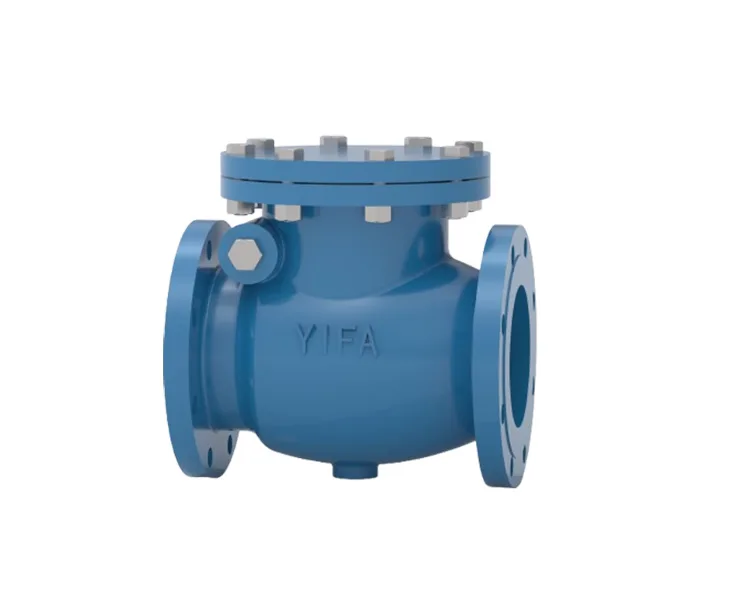
A swing check valve hangs a single disc on a hinge pin at the top of the body. Forward flow pushes the disc open against a stop. That is all it does. When flow stops or reverses, gravity and backpressure swing the disc back onto the seat.
Fully open, the disc swings clear of the bore. That gives a swing check the lowest pressure drop of any check valve type, and it is why swing checks remain the default on large water mains and process lines with steady flow. The body is full-bore and the design is simple: no springs, few moving parts, field-repairable through a bolted cover.
The weakness is timing. The disc travels a long arc from wide open to seat. On a pump trip, the flow column decelerates and reverses while the disc is still swinging. The disc slams onto the seat under reverse velocity. The stopped water column dumps its kinetic energy into one pressure spike. Water hammer.
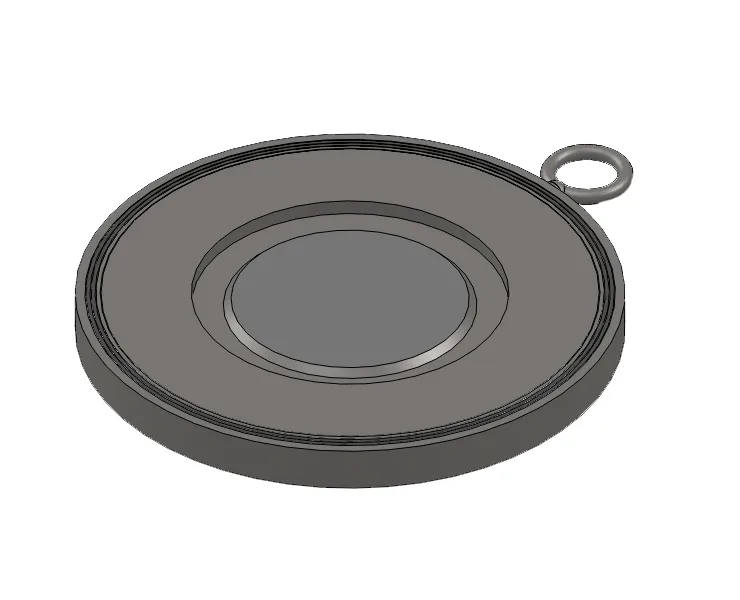
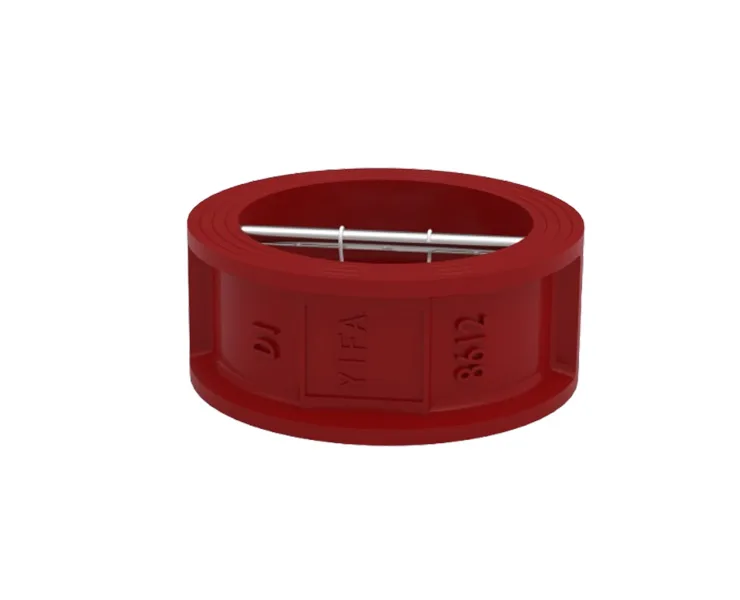
A wafer check valve in the dual plate configuration replaces the single disc with two spring-loaded half-plates hinged on a central pin. Forward flow folds the plates open; the moment flow decays, torsion springs start closing the plates. The travel is short and the spring force does not wait for gravity.
The practical result: the valve is essentially shut before reverse flow establishes. That is the definition of non-slam behaviour in a compact package.
The other advantage is physical. A wafer dual plate check valve fits between two flanges in a fraction of the length and weight of a cast swing check body. The same duty that needs a 495 mm flanged swing check spool can be done by a valve around 130 mm face-to-face, at roughly a fifth of the weight.
The trade-off is a slightly higher pressure drop when open — the plates and central shaft sit in the bore — plus a small cracking pressure the spring imposes, and no in-line maintenance access. When it wears out, you pull the spool and replace the unit.
Everything else is secondary to this. A pump trips, the column reverses, and the disc has maybe a second to get out of the way. The swing check needs a long arc; the dual plate needs a few millimetres plus a spring.
Rule of thumb that holds in practice: on pump discharge lines above DN 200, or where flow velocity runs above 3 m/s, or where a pump trip would be a surprise to the operators — specify a fast-closing design. That is the dual plate wafer check. On large, low-velocity water mains where pressure drop is precious and slams are manageable, the swing check stays the workhorse.
A gravity swing check must be installed horizontal, or vertical with flow upward, so the disc can fall closed. Never install one in vertical down-flow — the disc cannot close reliably. Wafer dual plate checks are spring-driven, so they work in horizontal and vertical-up lines, and with the right spring specification, vertical-down as well.
If your line is vertical and the flow goes up, the dual plate check removes a whole class of installation mistakes.
Wafer and lug check valves — the dual plate family — are covered by API 594, which also sets the short-pattern face-to-face dimensions in its tables (for example, 60 mm at NPS 2 and 98 mm at NPS 6 for Class 150). Swing check valves are covered by API 6D or BS 1868 in many process specifications, with face-to-face per ASME B16.10.
The two are not interchangeable on a datasheet. If the spec says API 594 short pattern, you need a wafer dual plate valve. If it says BS 1868 or API 6D full-bore, you need a swing check. Mixing them up on a P&ID is a real-world error that costs a re-order and a shutdown.
Engineering ToolBox's valve operating temperature tables are a useful sanity check for the whole family: check valves appear with broad temperature ranges in clean service, but in practice the elastomer seat sets the ceiling, and YIFA's dual plate wafer check valve is rated for -20 °C to 120 °C with EPDM, NBR, PTFE or Viton sealing options.
Put a wafer check on a HVAC cooling circuit, a fire pump discharge, or a water treatment pump skid where space is tight and a slam would be bad news. Our YFH77X dual plate wafer check valve, with GGG40, WCB, or stainless bodies and wafer connection in DN50-DN800, is built for exactly that duty. For space-critical installations, the YFH74 ultra-thin wafer check valve is another compact option.
Put a swing check on a large water transmission main or a process line where the flow is steady, the bore has to stay clear, and the crew wants to service the disc in place. Our YFH44 flange swing check valve covers that side of the family, flanged from DN50 to DN600 with a rocker-arm design and sealing options from brass to 13Cr to stainless steel.
You can compare the whole family on our check valve category page and see how they are applied in water treatment systems.
Ask two questions, in order. First: can the disc afford to close slowly? If a pump trip is possible and the line is big or fast, you need the fast-closing wafer dual plate check. Second: does the bore need to stay clear, or does the line have to be serviceable in place? If yes to either, the swing check earns its weight.
Everything else — pressure drop, weight, price — is small change next to those two answers.
Not sure which applies to your line? Send us your pump size, discharge velocity, and orientation, and our engineers will confirm the right check valve within 24 hours.